Wednesday, July 13, 2011

branch house by KINO architects


'branch house' by KINO architects in fukushima, japan
all images courtesy KINO architects
image © daici ano


japanese practice KINO architects (masahiro kinoshita) has sent us images of 'branch house', a private dwelling for a four person family in a residential area in fukushima, japan.
treating the communal space as the center of the design, the house 'branches off' to arrange its private functions at its perimeters. 


fly-by view
image © daici ano


situated on a long site, the single-storey residence is significantly stepped back from the street line to achieve a private distance from the neighbourhood. each branch terminates with a closed-face of vertical-running panels, and draws a playful and asymmetrically-pitched profile. in contrast, the elevations in between are finished in a bright shade of white, accentuating the four diverging wings as though they were cut from a large mass.


exterior view
image © daici ano


view from one of the gardens
image © daici ano


image © daici ano


at the center, the communal living and dining space becomes the core of the layout with the master bedroom, children's room, kitchen, bathroom and guest room branching outwards.
each room features a loft level that functions as appropriate storage space - or a play area in the children's room - for the respective program. a series of columns provides support as well as highlights the rhythmic finish of the exposed roof structure made out of wood. surrounded by four gardens, the distance between the rooms facilitate natural daylighting and cross ventilation.
the sprawling layout also aids in resisting possible earthquakes in the area.


interior view
image © daici ano


living room
image © daici ano


image © daici ano


exposed roof structure
image © daici ano


ladder up to loft level
image © daici ano


view from loft
image © daici ano


image © daici ano


images © daici ano


image © daici ano


night view
image © daici ano


image © daici ano


image © daici ano


schematic diagram


site map


floor plan / level 0


floor plan / loft level


structural diagram


project info:

principal use: private residence
structure: wooden
storeys: one
site area: 344.26 m2
building area: 120.61 m2
total floor area: 176.70 m2


via designboom 

infinite loop by tim gushue

 
'infinite loop' stand for tablets and smartphones, designed by tim gushue


'infinite loop', invented by designer and engineer tim gushue, offers a multipurpose, extensible stand for tablets and smartphones.
the flexible device can be bent into any shape as it holds up mobile devices via suction cup, and gushue has just been in touch with designboom to preview a series of accessories he plans for upcoming release into the 'infinite loop' system, including clip-on speakers, a USB module, and a camera screw thread adapter.

composed of co-molded metal and plastic, 'infinite loop' is produced in a two-foot long 'mini loop' and a four-foot standard model.
the adjustability of the loop, which supports devices via suction caps and adjustable side clips, makes it compatible with a range of tablets, including iPad, playbook, and zoom, as well as kindles and other e-readers, while the mini loop fits all apple phone and touch products, as well as 'virtually any other smartphone that you can stick a suction cap to'.


rear view of one possible configuration


full view bent (left) and rolled up when not in use (right)


'infinite loop' as a whole is designed for extensibility and range of use. the device's durable but flexible material can be formed into a range of shapes for use on flat surfaces, wrapped around poles, hung over objects, and in other environments.
the system is also modular, so multiple 'infinite loops' can be connected together to adapt to additional settings.
when not in use, 'infinite loop' can be rolled up into a compact circle.


because devices are supported simply by the attachment of a suction cup, the stand is compatible with a range of devices


composed of flexible metal and plastic, the stand can be bent into a range of configurations 


gushue has already designed a line of accessories for 'infinite loop', including adapters that permit other kinds of devices such as handheld cameras to be supported. components like clip-on speakers and a USB-port loop segment add functionality to the product's use with tablets and phones.

funded largely via kickstarter, where preorders-qua-funding are accepted through july 22nd, the standard and mini 'loops' are expected to be available this august.


accessories planned for the device include clip-on speakers


a second model of clip-on speakers


additional accessories include adaptor mounts for other devices, such as cameras


also planned for inclusion in the 'infinite loop' system is a segment with a USB port


examples of use

via designboom 
via tekmap

Sustainable Running Shoe

Transition is a "back to basics" sustainably made running shoe that follows the barefoot style principle. Traditional running shoes are made of 52 components. This shoe is only made of 5. By avoiding glues and complex co-moulded parts, components are easily assembled and more importantly, recycled.

Transition Shoes is a 2011 IDEA Awards Winner!
Designer: Nicholas Couch
via tekmap 

Omer Deutsch’s - Plant/Computer Hybrid

Combining the computer world with the natural environment, Omer Deutsch's design, Secondary Growth, gives insight to what the future fusion of electronics and mother nature might look like. Complete with soil and germinated seeds, the system functions not only as a computer but as a home for the user's favorite plant, creating an interesting contrast between a constantly changing organism and an unchanging object of permanence.

The computer's exterior was designed not only to resist water but to use it for cooling the internal components.


Designer: Omer Deutsch 

via yankodesign  

via tekmap

Monday, July 4, 2011

florian beigel + ARU london: youhwadang book hall


the youhwadang book hall by florian beigel  and ARU
all photos by jonathan lovekin


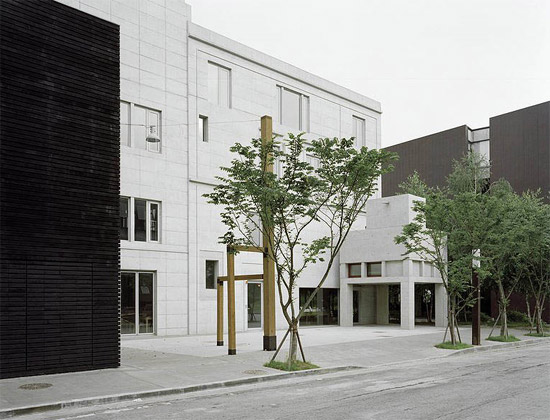
florian beigel and ARU (architecture research unit) london with choi jonghoon and NIA seoul designed youhwadang book hall, as part of paju book city in south korea.
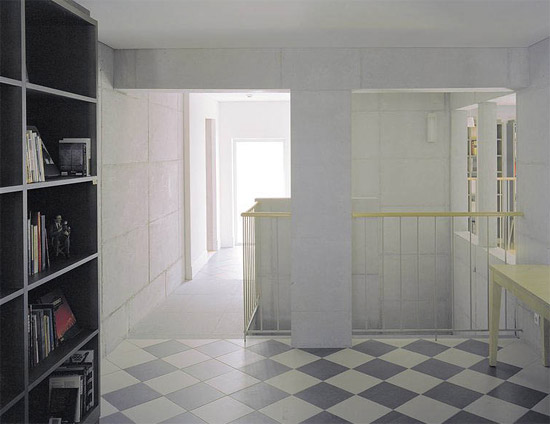
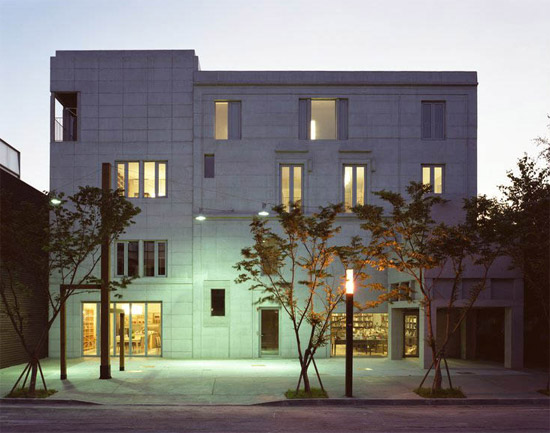
ARU previously completed two publishing houses at paju book city for youlhwa dang publishers. the book hall is third in a cluster of three buildings and is an extension of the publishers original black building. the book hall building is comprised of a little public square off book maker's street, which opens on to the art yard under a small portico building. the structure is composed of closely packed buildings next to and on top of one another. the different characteristics of the facade reflect the essential spatial differentiation behind the facades: book hall, mezzanine lounge, reading room, and a book café, with double storey apartments on top of it.


looking towards the art yard and entrance portico of the youhwadang book hall


entrance portico with the main facade facing the public art yard


the library


the interior


the interior


the youhwadang book hall in the evening


sketch of the book hall


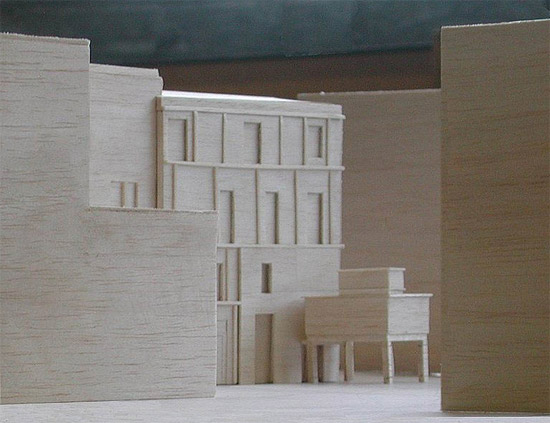
model of the facade


model of the book hall


model of the book hall


elevation view


floor plan


floor plan
source designboom